
International tax planning is not disappearing.
But a certain way of doing it is running out of road: open a company abroad, use a foreign address, obtain a residence visa, move money through another jurisdiction—and assume that incorporation alone determines where tax is due.
For years, international tax discussions have been crowded with formulas that sound simple enough to sell in a short video. Some are incomplete. Others are simply wrong.
As tax administrations become more data-driven, the weaknesses behind those formulas are becoming easier to identify.
A foreign company is not a tax strategy
Consider a familiar hypothetical.
Someone continues to live and work in their home country. Their personal and economic life remains centred there, and they manage the business from there. They then open a US LLC and assume that the foreign incorporation, by itself, moves the income outside their domestic tax position.
The problem is not the LLC.
A US LLC can be a legitimate and effective vehicle in the right circumstances. The problem is treating incorporation as a substitute for tax analysis.
It is not.
Personal tax residence, corporate residence, management and control, the location of economic activity, source-of-income rules, permanent-establishment exposure, reporting obligations and treaty provisions may all be relevant. Their application depends on the facts and on the jurisdictions involved.
The same distinction appears elsewhere. A residence visa is not automatically proof of tax residence, and a company registered in one country is not necessarily managed there.
Good international tax planning begins with those distinctions.
Sloppy planning ignores them.
The information is becoming more connected
Better analysis matters because more information is being collected in structured form.
Financial-account information can be exchanged under the Common Reporting Standard. The amended CRS extends that framework, while the Crypto-Asset Reporting Framework brings relevant crypto-asset transactions into the automatic-exchange architecture. First exchanges under these standards are due to begin from 2027, depending on each jurisdiction's implementation timetable.
Tax administrations may also receive information through company and beneficial-ownership registers, financial institutions, electronic invoicing, digital platforms and domestic government databases.
This is not one flawless global surveillance system. Information can be incomplete, access differs by jurisdiction and data does not interpret itself.
But relying on separate pieces of information remaining separate forever is becoming a weaker assumption.
The problem is inconsistency
Modern analytics is especially relevant where a structure tells several incompatible stories at once.
A person claims to have relocated, but their day-to-day personal and economic life remains overwhelmingly centred in the previous country.
A company is incorporated in Jurisdiction A, while its important decisions and actual management appear to take place in Jurisdiction B.
Related entities transfer funds between one another, but the contracts, invoices and accounting records do not clearly explain the commercial purpose of the flows.
A taxpayer adopts a treaty position that may be possible in principle, but cannot evidence the facts required to support it.
None of these circumstances, in isolation, automatically proves avoidance or evasion. International lives and businesses are often legitimately complex.
The risk lies in incoherence—and in being unable to explain it.
Better enforcement does not kill good tax planning
This is the distinction that matters most.
Countries still operate different tax systems. People can relocate legitimately. Businesses can establish real operations in new markets. Investors can structure international assets. Companies can use regimes enacted by governments when the applicable conditions are met.
Better enforcement does not remove those choices.
It increases the value of getting them right.
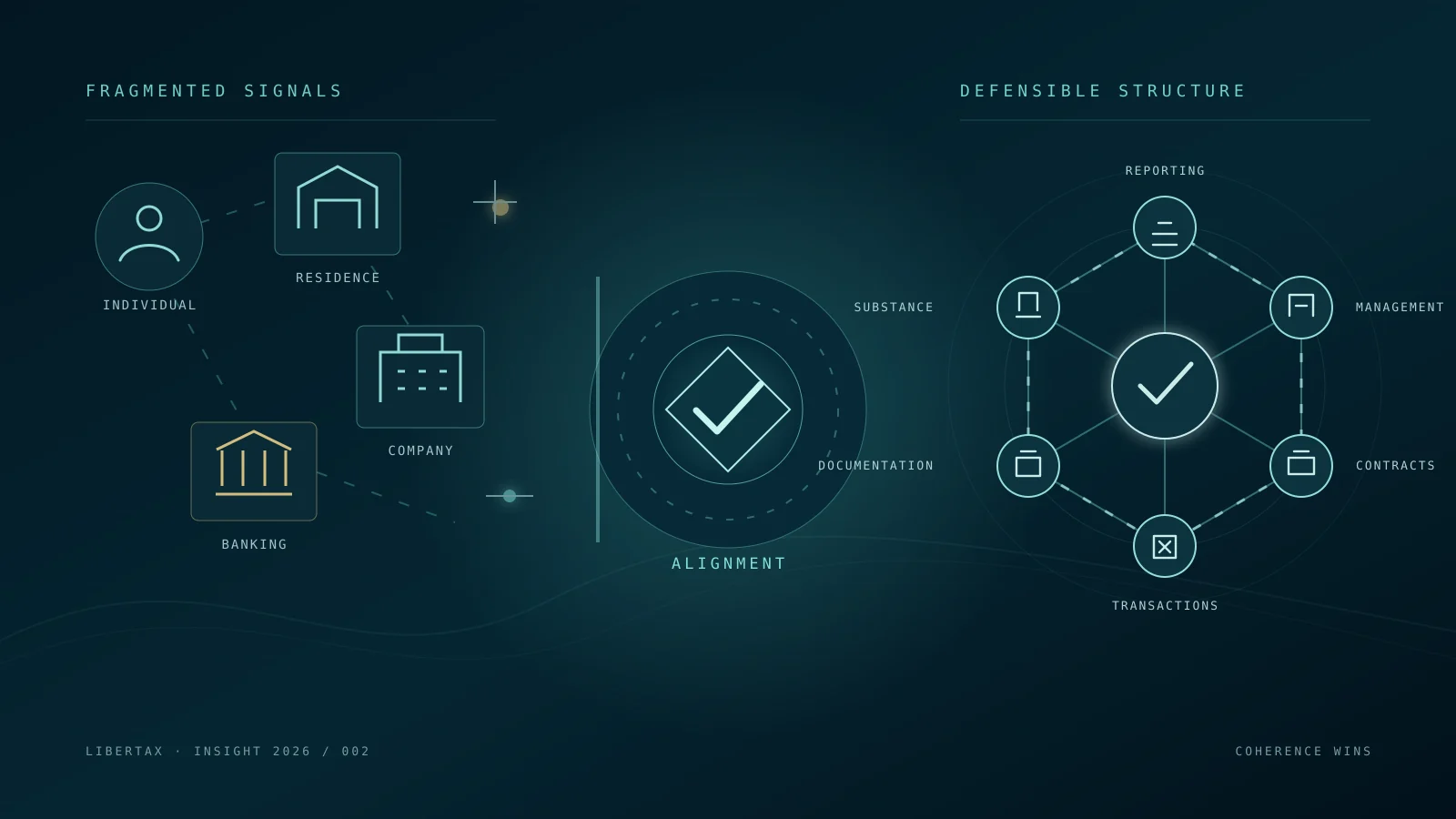
The question is not whether an international structure exists. The question is whether its legal form, economic reality and documented behaviour are aligned.
The new standard is defensibility
A well-designed structure should withstand straightforward questions:
- Where are you genuinely tax resident?
- Where is the company actually managed?
- Where does the economic activity take place?
- Do the contracts reflect what happens in practice?
- Does the accounting reconcile with the transactions?
- Are related-party flows commercially supportable?
- Is beneficial ownership recorded correctly?
- Can any treaty position be supported by the relevant facts?
- Is there appropriate substance where it is required?
- Are all applicable reporting and compliance obligations being met?
AI is not infallible
Tax technology should not be romanticised.
Algorithms can generate false positives, data can be incomplete and models can contain bias. A founder may genuinely live in one country, own companies in two others and invest across several more. Unusual does not mean abusive.
This is precisely why professional analysis, evidence and human judgement remain essential—for taxpayers as well as tax administrations.
Better technology does not eliminate legitimate international complexity. It makes explaining and documenting that complexity more important.
Coherence wins
For too long, parts of the international-structuring market have sold incorporation as if it were a complete strategy.
It is not.
The people and businesses best prepared for the next phase of international taxation will not necessarily be those who avoid cross-border structures. They will be those whose structures make sense legally, economically and operationally—and remain coherent as their circumstances evolve.
The era of international tax planning is not ending.
The age of sloppy tax planning is.
International tax planning built for the real world
A strong cross-border structure should do more than look efficient on paper. Residence, corporate structure, management, substance, documentation and compliance need to work together.
Libertax helps internationally mobile founders, investors and businesses build coherent cross-border structures designed to be both efficient and defensible.
Discuss your situationSources
- OECD — Artificial Intelligence in tax administration: From early innovation to modern transformation, 29 April 2026 ↗
- OECD — Tax Administration Digitalisation and Digital Transformation Initiatives, including Table 5.6 ↗
- OECD — Crypto-Asset Reporting Framework and amended Common Reporting Standard, 2 October 2024 ↗
- OECD Global Forum — Implementation of the amended Common Reporting Standard, 2026 ↗