
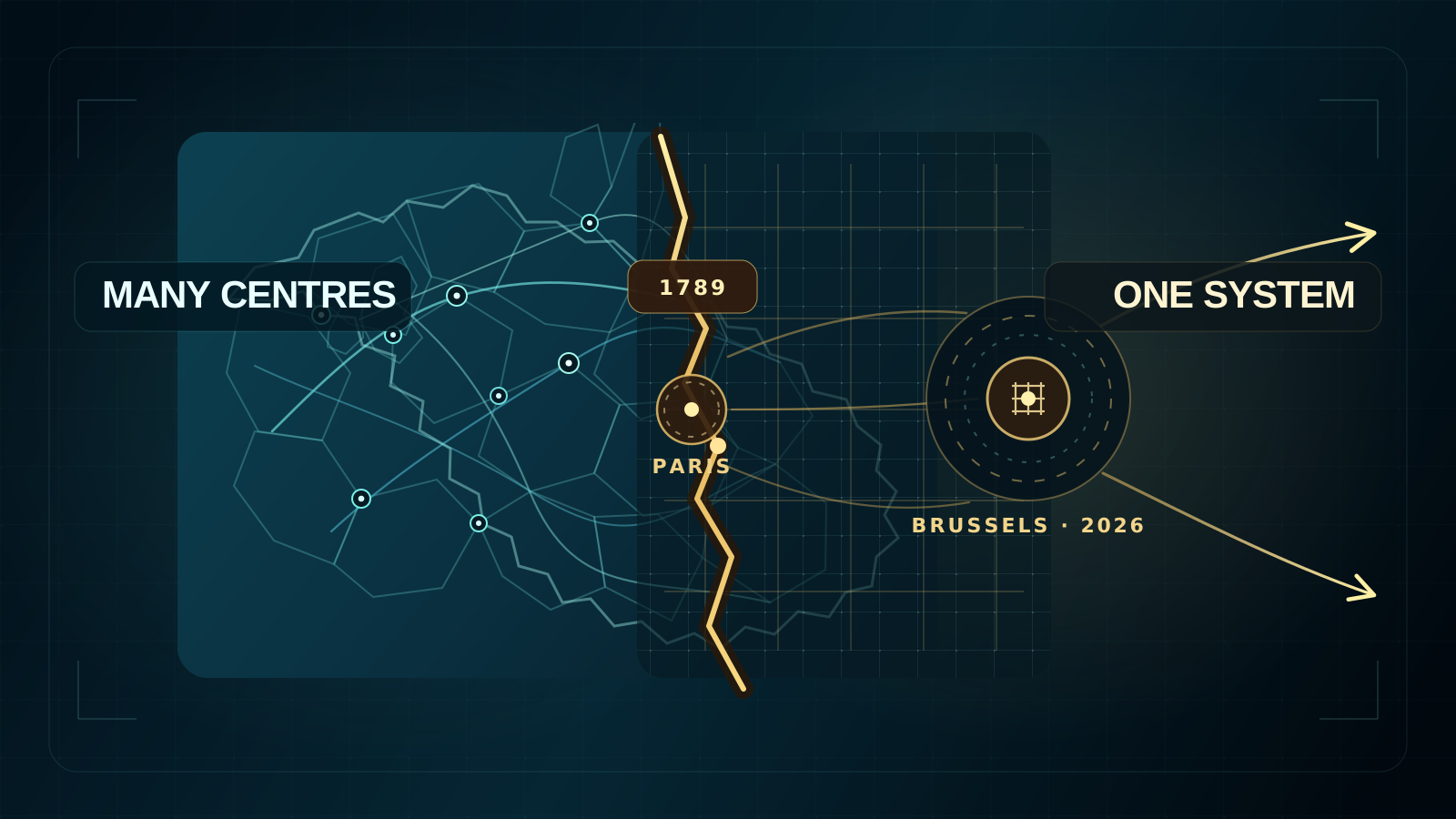
Europe’s genius was never political unity.
It was political division within a recognisable civilisation.
A scholar could travel between universities. A merchant could move through commercial cities. Law, Christianity, Latin learning, artistic forms and inherited customs created a common world. Yet no emperor, king, parliament or ministry possessed a permanent monopoly over the whole continent.
That lack of monopoly was not an administrative defect. It was one of Europe’s greatest protections.
A ruler could persecute, confiscate, debase, censor or overtax. But he could not easily prevent another city, prince, canton or republic from welcoming the people, capital and ideas he had driven away. Europe’s political borders were often obstacles to armies and bureaucracies while remaining porous to civilisation.
The modern centralising project has inverted that formula.
The French Revolution first attempted to convert a plural country into one rationally designed nation-state. The European Union now attempts to convert a plural civilisation into one regulatory space.
The instruments are different. The underlying ambition is recognisable.
Europe is not the European Union
The first intellectual error is to treat Europe and the EU as synonyms.
Europe is a civilisation older than every current institution. The European Union is a political and legal construction created by treaties, expanded by successive transfers of competence and administered through a permanent apparatus.
Europe would continue to exist without the Commission, the Council, the Parliament or the Court of Justice. Its languages, cities, markets, churches, universities, legal traditions and peoples do not depend on Brussels for their existence.
The EU’s strongest achievements came from removing barriers:
Those are liberal achievements because they reduce coercion.
The EU’s most damaging tendency begins when removal becomes replacement: instead of stopping states from obstructing exchange, the Union substitutes one continental rule for several competing national rules. The common market becomes the justification for a common regulator; the common regulator creates a common standard; the common standard produces agencies, reporting, implementing acts and enforcement; and each new layer generates the apparent need for the next.
That is not Europe overcoming nationalism. It is the nation-state method enlarged to continental scale.
- reducing customs obstacles;
- protecting movement across borders;
- limiting discrimination against people and firms from other Member States;
- enabling trade, establishment and capital to circulate more freely.
The Revolution’s enemy was provincial France
The French Revolution did not inherit a blank territory called France.
It inherited provinces, pays, cities, parlements, estates, customary laws, linguistic communities, churches, guilds, local privileges and overlapping jurisdictions. Many of those arrangements were unjust, closed or inefficient. Some privileges deserved abolition. But they also prevented the monarchy from governing every person and every locality through one uniform chain of command.
The monarchy had already advanced centralisation through intendants, taxation and administrative expansion. Tocqueville was right to insist that the Revolution did not invent the central state. It inherited and radicalised it.
What changed after 1789 was the legitimacy of plurality itself.
The new order no longer treated historical difference as something to negotiate. It treated it as an obstacle to national unity.
The debate over departments made the ambition explicit. Reformers proposed to reorganise France according to a more regular and supposedly rational territorial plan. Mirabeau warned against a mathematical division detached from locality and circumstance. The centralising vision prevailed: the old provinces ceased to be the principal administrative reality, and France was remade into departments operating under a common national system.
This was more than cartography.
A province is a historical community. A department is an administrative unit.
The change declared that territory belonged to the state before it belonged to memory, custom or local identity. Brittany, Burgundy, Béarn, Provence, the Basque lands and many other inherited political spaces were no longer legitimate centres of authority. They became cultural names inside a national machine.
The citizen was liberated from privilege—and isolated before the state
The Revolution’s defensible achievements should be stated plainly.
Equality before the law was an advance. The abolition of many hereditary privileges was an advance. Greater freedom of occupation and enterprise contained a genuinely liberal element. The Declaration of the Rights of Man and of the Citizen articulated principles that could be used against arbitrary power.
But the Revolution did not stop at limiting power.
It destroyed or subordinated institutions standing between the individual and the nation. The Civil Constitution of the Clergy reorganised the Church under national authority and required oaths to the new order. The Le Chapelier Law prohibited professional corporations and collective organisation around shared occupational interests. The National Assembly’s own historical account notes that restrictions flowing from that revolutionary settlement constrained collective association for more than a century.
The revolutionary ideal was not a dense civil society composed of freely cooperating institutions. It was a flat political space containing the individual and the nation.
The individual was declared free from old bodies, then placed directly before a state claiming to embody the general will.
That structure is central to modern mass politics. It is easier for a central authority to govern isolated individuals than autonomous provinces, churches, municipalities, guilds, universities, families and voluntary associations capable of resisting it.
The Revolution abolished some coercive monopolies and created a much larger one.
Vendée: exterminatory power in the name of the nation
The War in the Vendée exposes what happens when a central state interprets resistance not as a political conflict but as a disease inside the national body.
The immediate causes were multiple: religious conflict after the Civil Constitution of the Clergy, hostility to revolutionary administration, local social tensions, royalism and, decisively, the levy of 300,000 men in 1793. The revolt became a brutal civil war in which atrocities were committed by both sides.
The scale and language of republican repression, however, cannot be reduced to ordinary counter-insurgency.
The Convention adopted measures explicitly framed around the destruction of the rebellion. Republican forces later known as the “infernal columns” practised scorched earth across the military Vendée. The Bibliothèque nationale de France summarises their actions as arson, pillage, rape and massacre. Modern estimates discussed in the Cambridge World History of Genocide reach up to roughly 170,000 insurgent deaths and 30,000 republican military deaths, although all figures remain contested.
Whether the repression satisfies the modern legal definition of genocide remains a serious historiographical dispute. That dispute should not be hidden, but neither should it become an excuse for euphemism.
There was exterminatory rhetoric. There were decrees of annihilation and extermination. There was the deliberate destruction of settlements, crops and civilian life. There were killings of women and children after the principal rebel armies had already been broken.
At minimum, the Vendée was a campaign of mass state terror against a population treated collectively as an internal enemy.
This is one of the darkest legacies of revolutionary sovereignty: the state no longer merely fights rival rulers. It purifies the people in whose name it claims to act.
The levée en masse turned the population into military material
European warfare before 1792 was not peaceful, humane or uniformly small. The Seven Years’ War alone was global and devastating. States used conscription, requisition and large armies before the Revolution.
But dynastic warfare was often constrained by limited fiscal capacity, professional military structures, diplomatic objectives and the fact that rulers did not yet claim to embody mobilised nations in the modern sense.
The levée en masse of 23 August 1793 changed the political grammar of war.
The decree placed the population and its productive capacity in permanent requisition for the armies. Young men would fight; married men would manufacture and transport; women would produce and serve in hospitals; children and the elderly were assigned supporting and ideological roles. The nation was no longer merely financing an army. The nation became the army.
Recent Oxford scholarship describes this process as the “totalisation” of war and the ideal of the nation in arms. The French Revolutionary forces mobilised hundreds of thousands on a scale that challenged the assumptions of eighteenth-century warfare.
The moral transformation was as important as the numerical one.
A soldier fighting for a prince can be defeated without the whole people being dishonoured. A nation in arms experiences defeat as national humiliation and victory as moral vindication. War becomes a struggle of peoples, identities and ideologies rather than only governments.
Napoleon inherited this machine, professionalised it and exported it across Europe.
From Napoleon to the age of national war
It would be historically crude to claim that 1789 mechanically caused the Franco-Prussian War, the First World War or the totalitarian regimes of the twentieth century.
History does not operate through one straight line.
But the revolutionary and Napoleonic era created a repertoire that later movements intensified:
The Franco-Prussian War and the national revanchism that followed belonged to a world shaped by that repertoire. The world wars expanded it through industrial technology, bureaucratic capacity and racial or ideological mobilisation. Fascism and communism did not simply descend from the French Revolution, but they recognised and reused several of its instruments: the vanguard claiming to embody the people, unlimited political sovereignty, purification, mobilisation and the subordination of private life to a collective historical purpose.
The Revolution did not invent every modern tyranny.
It helped make unlimited politics imaginable.
- national sovereignty treated as indivisible;
- the population mobilised as an economic and military resource;
- political legitimacy grounded in an abstract people represented by the state;
- war presented as a struggle between nations and historical missions;
- internal enemies described as obstacles to collective regeneration;
- emergency government justified by existential danger;
- state-directed education, symbols and political religion used to manufacture loyalty.
Brussels continues the project through law
The European Union is not revolutionary France. It has no Committee of Public Safety, no levée en masse and no infernal columns. Its centralisation is legal, administrative and incremental.
That distinction matters morally. It does not eliminate the institutional comparison.
Article 5 of the Treaty on European Union formally limits Union action through conferral, subsidiarity and proportionality. Competences not conferred remain with the Member States. In non-exclusive areas, action should occur at Union level only when objectives cannot be sufficiently achieved below it.
In practice, subsidiarity is a remarkably weak brake. The European Parliament’s own fact sheet records that the Court of Justice has never struck down a measure for breaching the principle.
The process therefore contains a structural bias:
1. identify a cross-border problem; 2. declare national variation an obstacle; 3. propose a European framework; 4. add delegated and implementing rules; 5. create agencies, reporting systems and expert groups; 6. discover inconsistencies at the edges; 7. harmonise again.
The central power rarely needs to announce a grand constitutional seizure. It grows through accumulation.
EUR-Lex records 1,775 basic and amending acts adopted by the Commission in 2025 across delegated, implementing and other categories. Not every act was a major regulation; many were technical decisions or amendments. That is precisely the point. Contemporary centralisation is not one dramatic law. It is a permanent production line.
The bureaucracy is not omniscient
The standard defence of Brussels is that modern life is complicated and therefore requires specialised administration.
Modern life is complicated. That is the argument against centralisation.
The Commission employs around 32,000 permanent and contract staff. The EU Agencies Network reported in 2026 that 52 agencies and joint undertakings supported more than 14,000 additional staff. The European Court of Auditors describes the broader Union as seven institutions and more than 50 agencies and other bodies.
Those people are not necessarily stupid, corrupt or lazy. Many are highly qualified.
The problem is more fundamental: no bureaucracy can possess the dispersed knowledge required to decide correctly for hundreds of millions of people, millions of firms and radically different local conditions.
The Commission itself acknowledges the limit. Its register of expert groups explains that, despite considerable internal expertise, it needs outside specialists to prepare legislation, delegated acts and implementation.
That dependence creates a predictable chain:
The issue is not a shortage of intelligent bureaucrats. It is the impossibility of intelligent central planning.
- officials define a policy problem they cannot personally master;
- outside experts, industry representatives, NGOs and consultants supply knowledge;
- committees translate contested judgements into technical recommendations;
- political institutions adopt rules whose real assumptions few voters can identify;
- national administrations enforce them;
- responsibility becomes impossible to locate.
Harmonisation is often cartelisation
Competition is welcomed when it occurs between firms and treated with suspicion when it occurs between governments.
That asymmetry is convenient for states.
A country that taxes too heavily, regulates too aggressively or administers badly risks losing people, capital and businesses to another jurisdiction. That movement is a form of political discipline. It tells governments that their policies have a cost.
Harmonisation can neutralise that discipline.
Coordination reduces the number of dimensions on which jurisdictions can compete.
The same market that allows a consumer to choose among companies should allow a founder, investor or family to choose among jurisdictions.
Competition between jurisdictions is imperfect, but the answer should be targeted rules for concrete cross-border harms rather than one compulsory model.
Simplification is a confession, not a cure
By 2026, the Commission was openly acknowledging that administrative burden had become an obstacle to European growth. It set targets to reduce recurring burdens by at least 25% for businesses generally and 35% for SMEs, with expected savings of €37.5 billion by 2029. Half of the proposals in the 2026 work programme were described as simplification proposals.
This is welcome as far as it goes.
It is also an extraordinary admission.
A system does not promise to recover €37.5 billion from administrative burden unless the burden is already vast. A bureaucracy that spends one legislative cycle simplifying the output of previous legislative cycles has not changed its governing logic. It has begun auditing the cost of its own expansion.
EU Inc. offers a more defensible direction because it is proposed as an optional corporate regime alongside national forms. An additional option can increase freedom. A compulsory replacement would reduce it.
The distinction should become Europe’s constitutional rule:
Europe should be a market and a civilisation—not a state in waiting
The alternative to centralisation is not closed nationalism.
Returning every competence from Brussels to Paris, Madrid, Rome or Berlin would merely move the monopoly one level down. The nation-state itself is a product of centralisation.
Nor should Europe retreat into tariffs, currency controls, border obstruction or autarky. Political exit depends on economic openness.
A genuinely European order would be radically simpler:
Europe does not need another sovereign.
It needs sovereigns to compete, cities and regions to recover authority, and individuals to retain the practical ability to leave.
- free movement of people, goods, services and capital;
- mutual recognition where equivalent outcomes can be demonstrated;
- common action for clearly defined cross-border externalities;
- optional European regimes where scale creates value;
- independent dispute resolution for treaty obligations;
- cooperation on infrastructure where scale is necessary;
- periodic review of common rules and their practical effects;
- room for institutional diversity.
From institutional choice to jurisdictional planning
For founders, investors and internationally mobile families, institutional differences are practical rather than abstract. They shape residence, company management, banking, licensing, ownership records, tax treatment and reporting obligations.
Jurisdictional diversity creates alternatives. It does not make facts optional.
Company formation, residence permissions and registered addresses are only parts of a wider factual analysis.
The practical questions come before the jurisdiction:
This is where Libertax begins: not with a country to sell, but with a person, a business and a comparison of the jurisdictions genuinely available to them.
The task is to compare legal systems, identify their trade-offs and build a structure in which residence, management, activity, ownership, banking, documentation and reporting tell the same story.
- Where will the person actually live?
- Where will strategic decisions be made?
- Where are clients, staff, assets and operational risk located?
- Which banks and regulators must understand the structure?
- What evidence and reporting will make the arrangement defensible?
Recover Europe’s institutional genius
The argument is not that every old institution was good or that political fragmentation was peaceful. European history contains persecution, privilege and war as well as commercial and intellectual competition.
The narrower lesson is institutional: a civilisation with many centres of power retains more room for comparison, experimentation and correction than a system that makes uniformity the default response to difference.
European cooperation is most valuable when it keeps markets open, protects mobility and addresses genuinely cross-border problems without treating every national or regional variation as a defect.
Europe can remain culturally connected and economically open while preserving meaningful political plurality.
Sources and institutional context
- French National Assembly — Declaration of the Rights of Man and of the Citizen ↗
- French National Assembly — The first written French Constitution, September 1791 ↗
- French National Assembly — Thouret’s first speech on the territorial division, 3 November 1789 ↗
- French National Assembly — Thouret’s second speech on the territorial division, 9 November 1789 ↗
- French National Assembly — The Le Chapelier Law, 14 June 1791 ↗
- French National Assembly — Consulate, centralisation and creation of the prefectural corps ↗
- French National Assembly — Decree placing the French people in permanent requisition, 23 August 1793 ↗
- Bibliothèque nationale de France — Colonnes infernales, War in the Vendée ↗
- Cambridge University Press — Genocide in the Vendée ↗
- Oxford University Press — The Revolutionary and Napoleonic Wars and the totalisation of war ↗
- EUR-Lex — Article 5, Treaty on European Union ↗
- European Parliament — The principle of subsidiarity ↗
- European Commission — Commission staff ↗
- EU Agencies Network — Strategic priorities for 2026–2027 ↗
- European Court of Auditors — Institutions and bodies ↗
- European Commission — Register of Commission expert groups and similar entities ↗
- EUR-Lex — Legal acts statistics by author, 2025 ↗
- European Commission — Simplification and implementation agenda ↗
- European Commission — EU Inc.: a new harmonised corporate legal regime ↗