
Monday, 9.06 am. A Dubai consultancy finishes a project and emails its customer a polished PDF. The sales system says ‘sent’. The customer’s accounts team retypes the figures. The bookkeeper enters them again. Three people now possess three versions of one transaction, and everybody calls this digital.
Under the UAE e-Invoicing system, that PDF is not the electronic invoice. The invoice is structured data that can be issued, checked, exchanged and processed by machines. A readable document may still be useful for human eyes, but attaching it to an email does not satisfy the new definition.
This is more than a tax-format change. It reaches into customer records, product and VAT coding, credit notes, approval workflows, ERP exports and the quiet collection of spreadsheets that many businesses discover only when somebody asks how an invoice was actually produced.
The first mandatory go-live is 1 January 2027 for persons with annual revenue of at least AED 50 million. Following the 2026 amendment, those businesses must appoint an Accredited Service Provider by 30 October 2026. Smaller businesses follow in July 2027. The sensible response is neither panic nor procrastination: understand the flow, find the missing data and test the awkward cases before the deadline tests them for you.
The invoice is no longer the attachment
Ministerial Decision No. 243 of 2025 defines an Electronic Invoice as one issued, transmitted and received in a structured electronic format that enables automatic processing. The Ministry of Finance and Federal Tax Authority are unusually clear about the consequence: a PDF, Word document, image, scan or email is not an e-Invoice.
The official UAE model uses XML and the national PINT-AE specification, built within the Peppol interoperability framework. That does not mean the finance team must learn to read XML. It means the accounting or invoicing system must produce complete, correctly classified data that an Accredited Service Provider can validate and exchange.
A human-readable representation can still accompany the process. But it is now the window onto the invoice, not the invoice’s operative digital form. Redesigning the template while leaving customer identifiers, tax categories and line-level data in disarray is decorating the wrong problem.
Revenue changes the date, not the basic direction
The starting scope in Ministerial Decision No. 243 is broad: any person conducting business in the UAE, in respect of business transactions, unless the person or transaction is excluded. The official guidelines say VAT registration status does not by itself decide whether a business is in scope.
The phased timetable uses annual revenue to decide when mandatory implementation begins. It should not be mistaken for a permanent exemption for smaller businesses. Business-to-business transactions are the centre of the regime, and supplies to government entities are also covered. Government entities have their own implementation phase.
Business-to-consumer transactions are currently outside the Electronic Invoicing System until a future Ministerial decision says otherwise. A person engaged exclusively in B2C transactions is therefore not required to implement it for now. A mixed business cannot treat that exclusion as permission to ignore its B2B or B2G activity.
There are narrower exclusions, including qualifying sovereign activities, specified airline transactions and certain exempt or zero-rated financial services. These are legal categories, not industry nicknames. A business near an exclusion should map the exact transaction rather than assume the whole entity has disappeared from scope.
The calendar, as confirmed on 7 September 2026
The official timetable places the pilot programme and voluntary implementation from 1 July 2026. Voluntary adopters must follow the technical requirements, although the official guidelines state that e-Invoicing administrative penalties apply only from the date on which mandatory implementation applies to that person.
For persons with annual revenue equal to or above AED 50 million, Ministerial Decision No. 66 of 2026 moved the deadline to appoint an Accredited Service Provider from 31 July to 30 October 2026. It did not move the mandatory implementation date of 1 January 2027.
For this timetable, revenue means the gross income of the business conducted in the UAE during the most recent Accounting Period. Decision No. 66 is the later legal amendment and its 30 October date therefore takes precedence over the older 31 July table still visible in version 1.1 of the guidelines.
Persons below AED 50 million revenue must appoint an Accredited Service Provider by 31 March 2027 and implement by 1 July 2027. Government entities must appoint a provider by 31 March 2027 and implement by 1 October 2027.
- From 1 July 2026: pilot and voluntary implementation.
- 30 October 2026: provider appointment deadline for revenue of at least AED 50 million.
- 1 January 2027: first mandatory business phase goes live.
- 31 March 2027: provider deadline for businesses below AED 50 million and government entities.
- 1 July 2027: mandatory implementation for businesses below AED 50 million.
- 1 October 2027: mandatory implementation for government entities.
One sale, five corners and several confirmations
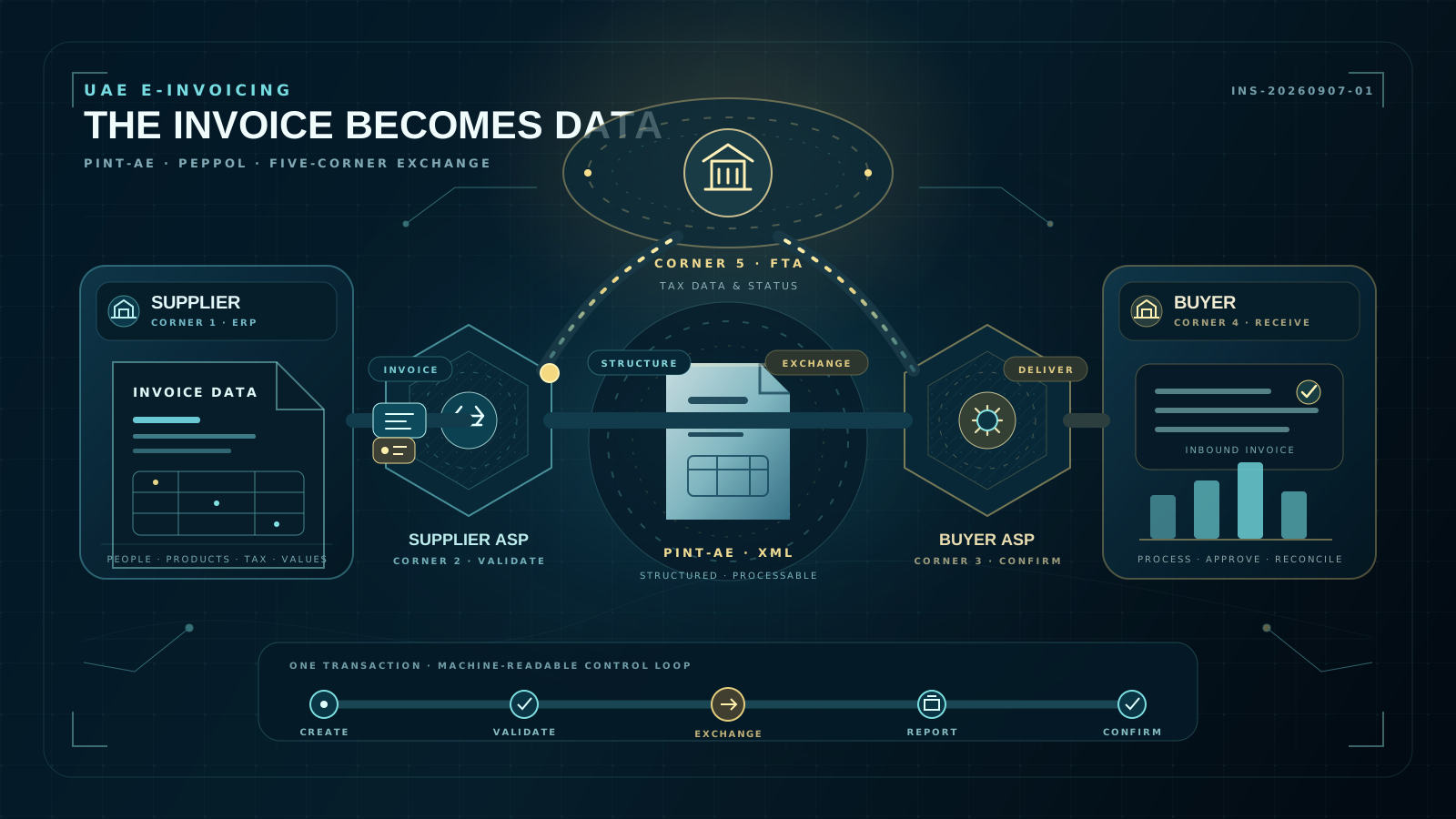
The UAE describes a five-corner model. Corner 1 is the supplier. Corner 2 is the supplier’s Accredited Service Provider. Corner 3 is the buyer’s provider. Corner 4 is the buyer. Corner 5 is the Federal Tax Authority.
The supplier sends invoice data to its provider in an agreed format. That provider validates the data and, where necessary, converts it into the UAE standard XML invoice. It sends the structured invoice to the buyer’s provider and reports the required Tax Data Document to the FTA in parallel.
The buyer’s provider validates the invoice, returns a message-level status, delivers the invoice to the buyer in the agreed format and, after successful validation, reports tax data to the FTA. Confirmations then travel back through the chain. A failed validation is therefore not a decorative warning: it is an operating event that somebody must own, correct and reconcile.
The providers move and validate the information, but the legal obligations do not evaporate into the network. The issuer remains responsible for issuing correctly; the recipient must process electronic invoices through the system; and both appoint accredited providers for their respective role.
This is an accounting-data project wearing a tax badge
The comfortable version of implementation is to buy a connector and declare victory. The less comfortable version is to ask whether the source systems contain the mandatory data consistently. That second question is where readiness begins.
Customer and supplier records need dependable identifiers. Invoice lines need correct descriptions, units, currencies and tax categories. Credit notes must point back to the right commercial event. The business must know which system creates the authoritative value and what happens when sales, operations and accounting disagree.
The official guidelines tell businesses to identify ERP or accounting changes, complete any necessary integration with the provider, test exchange and reporting end to end, and establish governance for errors. In practice, the useful test set is not ten perfect domestic invoices. It is the untidy edge: advance payments, foreign customers, self-billing, discounts, mixed VAT treatment, credit notes and the buyer whose master data has not been touched since 2019.
Businesses should also decide how confirmations and rejections return to the ledger. An invoice marked ‘sent’ inside the ERP is not necessarily an invoice successfully exchanged and reported. Without a reconciliation loop, automation merely allows an error to travel faster.
Choose the provider around the operating model
A business must select an Accredited Service Provider from the Ministry’s current list, enter into a commercial agreement and initiate onboarding through EmaraTax. The guidelines say each person or government entity should onboard with one provider for all its e-Invoicing requirements.
Accreditation is necessary, but it does not make every provider equally suitable for every business. The practical questions are integration method, implementation capacity, support coverage, error handling, security, data hosting, language, pricing and whether the provider can support the actual transaction volume and edge cases.
Ask to see the failure journey, not only the successful demonstration. Who receives the alert? Can the finance team identify the rejected field? Does correction preserve the audit trail? How are inbound invoices delivered? How does the provider support a system outage? A beautiful dashboard is welcome. A recoverable process is better.
A practical readiness checklist
The implementation can be made manageable by separating legal scope, data, technology and operations. The following list is deliberately practical: each answer should have an owner and evidence, not simply a reassuring green cell in a project plan.
- Confirm which entities and B2B, B2G and excluded transaction types are in scope.
- Calculate the relevant annual revenue and record the applicable provider and go-live deadlines.
- Map every invoice and credit-note source, including manual and specialist systems.
- Compare existing master and transaction data with the current PINT-AE mandatory fields.
- Clean customer identifiers, tax details, addresses, currencies, units and VAT classifications.
- Select an accredited provider and agree integration, security, support and error ownership.
- Test outbound invoices, inbound invoices, reporting confirmations, rejections and corrections.
- Reconcile provider statuses to the accounting ledger and retain the required records in an accessible and reproducible form in accordance with the applicable retention requirements.
- Train sales, finance and operations on what changes when an invoice fails.
- Monitor the Ministry and FTA portals for later technical guidance, exclusions and B2C decisions.
What is fixed—and what must still be watched
The legal direction, core scope, phased dates, accredited-provider requirement and structured exchange model are established. For the first mandatory phase, the amended 30 October 2026 appointment deadline and 1 January 2027 implementation date are not merely a consultation timetable.
The programme is still being implemented. The Ministry says its e-Invoicing portal is the official source and should be checked as the programme evolves. The accredited-provider list is updated periodically. Technical specifications and guidance can develop, additional exclusions may be issued, and B2C transactions remain outside the system until a future Ministerial decision.
That distinction matters. A company should not postpone the work that is already knowable—scope, data ownership, system mapping and provider selection—while waiting for every technical detail to stop moving. Nor should it hard-code an early interpretation and call it compliance. Build the core now; keep the edges capable of change.
Official primary sources
- UAE Ministry of Finance — eInvoicing programme portal ↗
- UAE Ministry of Finance — Electronic Invoicing Guidelines, version 1.1 (1 June 2026) ↗
- Ministerial Decision No. 243 of 2025 — Electronic Invoicing System ↗
- Ministerial Decision No. 244 of 2025 — Implementation timetable ↗
- Ministerial Decision No. 66 of 2026 — Amended first-phase provider deadline ↗
- UAE Ministry of Finance — Accredited eInvoicing Service Providers ↗
- UAE Federal Tax Authority — UAE e-Invoicing overview ↗