For most of modern history, long-term planning rested on a surprisingly stable set of assumptions.
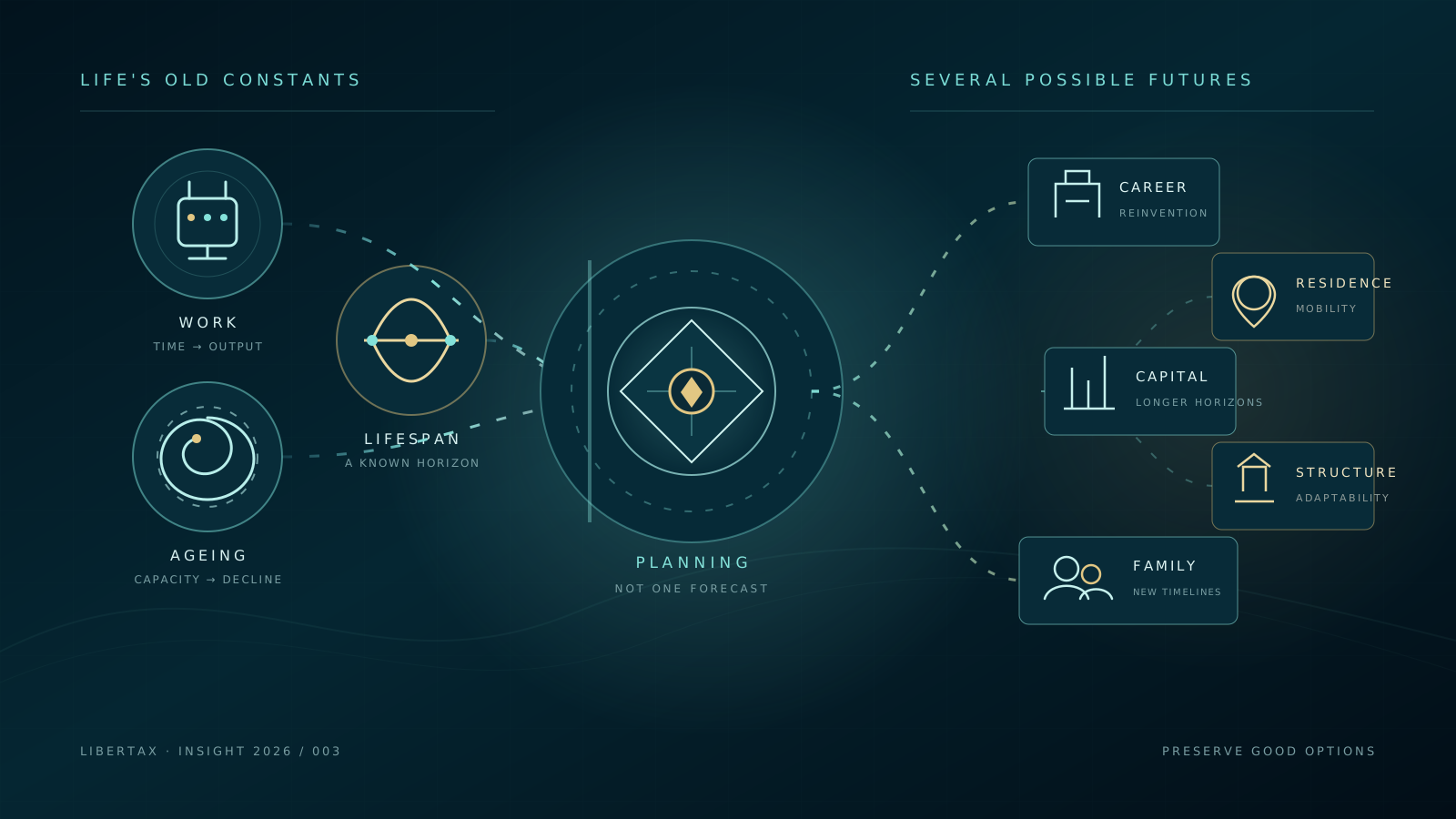
We expected to spend a large part of adult life working, to age in a mostly irreversible direction and to die within a relatively predictable human lifespan.
Those assumptions shaped education, careers, savings, retirement, investment, family decisions, residence, taxation and the way we valued time itself.
Technology is now beginning to question all three.
AI is beginning to change the meaning of work
Artificial intelligence does not need to eliminate work to change the assumptions behind it. It only needs to make more human cognitive labour cheaper, faster or unnecessary.
That shift is already visible, although it remains incomplete. Stanford's 2026 AI Index reports that accuracy on OSWorld, a benchmark of computer-based agent tasks, rose from roughly 12% to 66.3%. The same report stresses the limitation: today's agents still fail about one in three attempts on structured benchmarks.
The useful question is therefore not whether everyone suddenly stops working. It is whether the relationship between time, labour and economic output begins to weaken.
If one person assisted by increasingly capable systems can produce what previously required a team or weeks of work, career planning changes. So do the value of particular skills, the structure of organisations and the amount of lifetime that must be exchanged for income.
The OECD's 2026 work on AI and skills points to a less dramatic but more practical transition: successful adoption still depends on skills, training and the way jobs are redesigned. Human contribution changes before it disappears.
Longer healthy lives change more than retirement
The second assumption is biological. For centuries, longer life expectancy mainly meant reducing premature death through sanitation, nutrition, public health, vaccines and medical treatment.
That progress has already been extraordinary. The World Health Organization reports that global life expectancy at birth reached 73.3 years in 2024, 8.4 years higher than in 1995.
But living longer and ageing more slowly are not the same thing. WHO's healthy-ageing framework focuses on preserving functional ability: whether people can continue doing what they value, not simply how many years they remain alive.
There is no responsible basis today for declaring that ageing will be reversed or that radical life extension is inevitable. It may never happen. Yet even materially longer healthy adult lives would have consequences far beyond healthcare.
A retirement model designed around finishing work at 65 looks different if people remain healthy and productive much longer. A portfolio intended to support 20 years of retirement looks different if it may need to support 40. Starting a company at 55 looks different if 55 is no longer treated as the beginning of the final career phase.
Our planning systems assume a relatively predictable lifespan
Modern financial planning often works backwards from a broadly expected lifetime: accumulate assets during productive years, retire within a familiar age range, finance the remaining years and transfer what survives to the next generation.
Pensions, insurance products, estate-planning structures and many tax rules developed around similar assumptions. They do not require every life to follow the same path, but they do rely on ranges that have appeared stable enough to model.
Those assumptions are not about to collapse merely because new technologies exist. Their uncertainty may, however, increase. And long-term planning becomes more valuable—not less—when uncertainty increases.
The implication is not to stop planning
Rapid technological change can make planning feel pointless. The opposite is probably closer to the truth: good planning has never depended on predicting the future perfectly.
It depends on building financial, business and personal arrangements that remain useful across several plausible futures.
- Maintain flexibility instead of locking every decision to one expected career or retirement path.
- Avoid unnecessary complexity that becomes expensive to change when circumstances move.
- Preserve liquidity where it protects future choices.
- Be cautious with irreversible decisions based on uncertain technological forecasts.
- Review long-term assumptions periodically rather than treating an old plan as permanent truth.
Tax planning is downstream from life planning
Tax should rarely be the starting point. A structure that saves tax but constrains where someone can live, invest, operate a business or transfer wealth may be a poor structure.
The more fundamental questions come first:
- Where do you want to live?
- What do you want to build?
- How mobile do you expect to be?
- How much flexibility do you want to preserve?
- What risks are you actually trying to reduce?
Perhaps the deeper change is philosophical
Civilisation has transformed how we travel, communicate, produce and learn. Yet three conditions remained remarkably stable: we expected to work for much of our lives, our bodies to age in one direction and death to arrive within a relatively narrow biological horizon.
For the first time in modern history, technology is beginning to question all three at the same time.
We do not know how far any of these developments will go. AI may transform work without eliminating it. Medicine may extend healthy life without reversing ageing. Human lifespan may remain much closer to today's limits than some futurists expect.
Those are entirely plausible outcomes. But even asking the questions seriously is unusual.
Technology may no longer be changing only the environment in which human beings live. It may be beginning to change some of the basic terms around which we have organised human life.
If those terms change, the way we think about time, work, wealth and planning will have to change with them.
Sources and official context
- Stanford Institute for Human-Centered Artificial Intelligence — 2026 AI Index Report: Technical Performance ↗
- OECD — AI and skills: What we know so far, 5 June 2026 ↗
- World Health Organization — Ageing: Global population, 21 February 2025 ↗
- World Health Organization — Ageing and health, 1 October 2025 ↗