
International planning is often presented as a search for the best country, the lowest rate or the most flexible company. That framing is increasingly incomplete.
People move, companies operate across borders, banks reconstruct economic activity and authorities exchange more information. Artificial intelligence increases the speed at which separate facts can be compared. A structure that depends on those facts remaining disconnected is therefore becoming more fragile.
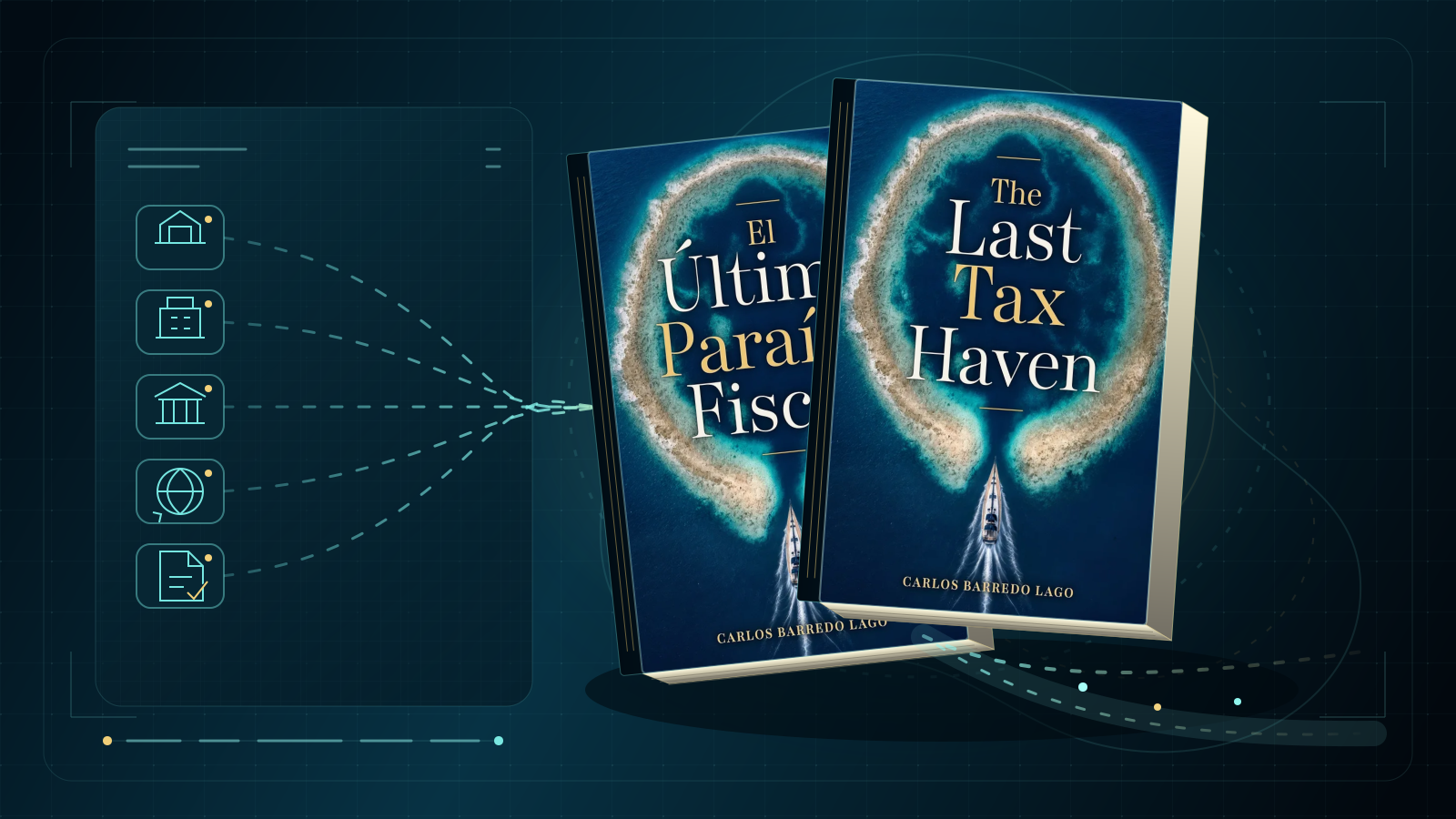
The Last Tax Haven develops a different proposition: durable freedom comes from coherence, optionality and evidence, not opacity.
The last tax haven is not an island
The title is deliberately paradoxical. The book is not a catalogue of offshore jurisdictions and does not promise a place beyond the law. It asks what remains valuable after automatic exchange, beneficial-ownership registers, stronger banking controls and data-assisted enforcement have reduced the distance between institutions.
Its answer is practical freedom: the capacity to live and operate internationally without a structure that collapses when a bank, regulator or tax authority asks ordinary questions. That freedom may include favourable tax treatment, but legality, family reality and resilience act as prior constraints.
Every part must support one coherent account
The book connects questions that are too often handled separately: where a person is resident, where a company is actually managed, how ownership is organised, what banks can verify, how mobility changes family and business ties, and which documents support the position.
None of those elements operates in isolation. A residence permit does not settle tax residence. Incorporation does not decide where management occurs. A licence does not guarantee banking. A legal arrangement that contradicts day-to-day conduct creates evidential risk even when each document looks acceptable on its own.
The central discipline is therefore alignment. Facts come first; jurisdictions and entities are selected only when they perform a real function within the whole.
Who the book is for
The Last Tax Haven is written for founders, investors, advisers and internationally mobile families who need a framework before they need another product. It is intended to improve the questions used to evaluate a move, a company, a banking relationship or a wider reorganisation.
It does not replace jurisdiction-specific legal or tax advice. Its role is to provide a decision architecture: optionality before optimisation, simplicity before proliferation and evidence before assertion.
- Use residence as a factual and legal analysis, not a day-count slogan.
- Treat company management and banking as part of the tax design.
- Prefer fewer purposeful entities to structures that exist only on paper.
- Build the evidence file before an institution asks for it.
The English edition is now available
The English edition of The Last Tax Haven is available through Amazon. The link above opens the corresponding English listing directly.
This Insight introduces the book's central thesis. Future Libertax analysis will continue to examine the individual residence, corporate, banking, mobility and technology questions that make that thesis operational.