
Imagine this. Friday, 5.43 pm. Dubai. The founder closes the laptop after approving a price, settling a delivery problem and deciding what the team will do on Monday. He lives in the UAE and runs the business from there. Then procurement emails: the client cannot replace the approved UK supplier this quarter. The payment provider also wants the Ltd to remain.
The business has moved. Part of its commercial plumbing has not. This is where a perfectly sensible relocation meets the untidy reality of clients, contracts and systems that refuse to travel on command.
Then comes the tempting sentence: ‘Easy. Charge 80% to Dubai as a management fee.’
No. That is not a pricing method. It is a desired tax result wearing an invoice—and it can turn a defensible move into a story nobody can explain without opening a PowerPoint.
The UK company may still have a perfectly legitimate job: preserving contracts, satisfying procurement, receiving payments or maintaining access to a market. The question is not whether it looks obsolete on the structure chart. The question is what it actually does—and what return that work deserves.
Nor should every founder rush to add a second company. Before building a UK–UAE structure, model the boring option: do nothing. If the benefit does not comfortably exceed the additional accounting, governance, evidence and tax friction, the sophisticated answer is to keep one company.
The UK company can stay—if it still has a job
A founder's move does not cancel a company. The UK Ltd may remain valuable because a material client will only contract with it, a procurement framework already approves it, a regulated payment route depends on it or the business still has people and operations in the United Kingdom.
Those are commercial reasons to keep the company. They are not automatic reasons to leave all the profit there. The analysis must separate legal continuity from economic contribution.
There is also a respectable one-company answer. The UK company can continue trading while the founder's UAE position, the company's possible UAE residence or permanent establishment and the continuing UK charge are reviewed properly. Keeping one company does not automatically mean keeping one tax jurisdiction. It may still be cheaper, clearer and harder to contradict than adding an entity with no real function.
What moved besides the founder?
Moving is a personal fact. Moving a business is a collection of economic facts. The founder may eat breakfast in Dubai while the team, contracts, assets and risks remain in the United Kingdom. The reverse may also be true: the contracting shell remains British while the real centre of the business has moved to the UAE. The direction of the flight does not, by itself, determine the direction of the profit.
Start with four things: people, functions, assets and risks. Who wins the clients? Who sets prices? Who performs the work? Who owns or develops the technology and brand? Who can bind the business to a contract? Who bears refunds, bad debts, delivery failures and regulatory exposure?
A registered office answers none of those questions. A bank account records where money arrived. It does not write the economic history of the business.
If the founder and operating team now work from Dubai, make the key decisions there and use assets controlled there, the UAE contribution may be substantial. If UK staff still manage client delivery, control important relationships and bear real commercial risk, the UK contribution may also be substantial. The point is not to award a flag to the whole profit. It is to map the business without flattering the intended answer.
- People: who performs and controls the economically significant work?
- Functions: which entity sells, delivers, manages and supports?
- Assets: who owns or legitimately uses the brand, systems, data and intellectual property?
- Risks: who has the authority and capacity to assume the commercial downside?
Two honest models—and one dishonest shortcut
In one model, the UK company remains the principal business. It owns the client relationships, contracts and relevant assets, while the UAE company supplies genuine operating or management services. The UAE company should receive an arm's-length return for the work, assets and risks it actually contributes.
In the second model, the UAE company becomes the principal. It controls the core business and contracts, while the UK company performs a narrower commercial, support or market-access function. That can be coherent, but an existing business may need contracts, customer relationships, intellectual property or goodwill to be transferred or licensed properly. Changing the logo on tomorrow's invoice does not move value created yesterday.
Imagine £600,000 of revenue and a spreadsheet that sends £480,000 to Dubai through a management fee. The spreadsheet looks beautiful: the profit lands exactly where we wanted it. Then the awkward questions arrive. Who signed the contracts? Who answers if the project fails? Who owns the client relationship? Who can dismiss the team or change the price? If almost every answer still points to the UK, the arithmetic may be flawless while the story is indefensible. If the UAE business genuinely performs and controls the core functions, a substantial return may be supportable—but only after the functions and pricing method are established.
Cost plus may be a sensible starting point for routine support services: it begins with the relevant documented cost base and a supportable mark-up. It is not a default price for strategy, customer creation, valuable intangibles or control of risk. A profit-based method has its own conditions. Neither starts with the tax bill and works backwards.
The costs that never appear in the structure diagram
On a slide, the structure is two neat boxes joined by an arrow. On Monday morning, it is two accountants, two corporate calendars, two sets of signatures and a founder explaining for the third time which company promised the client what. That is the part the tax-rate comparison usually forgets.
A second company adds another accounting system, tax return, corporate calendar, bank relationship, contract set and evidence trail. Related-party invoices must correspond to services actually supplied. The recipient must be able to show the business purpose and evidence behind a claimed deduction.
The UK's transfer-pricing exemption applies to most small and medium-sized enterprises, subject to exceptions. It does not make an arbitrary price commercially true, and it does not switch off the UAE transfer-pricing rules. The UAE applies the arm's-length principle to transactions with related parties and connected persons.
VAT is a separate layer. A UK business receiving many B2B services from a supplier outside the UK may have to account for the reverse charge. That can be cash-neutral for a fully taxable business, but not always, and it still requires correct treatment and records.
The comparison is therefore not ‘UK tax versus UAE tax’. It is the expected net benefit after two countries' compliance, professional costs, operational friction and the value of management time. A structure that saves on one line and leaks everywhere else is not efficient. It is merely busy.
A second company can also create a second residence problem
A UK-incorporated company is generally UK resident under UK domestic law. The UAE can separately treat a foreign juridical person as resident where it is effectively managed and controlled in the UAE. A founder who moves to Dubai and continues directing the same UK company may therefore create a residence question rather than a clean migration by osmosis.
Do not assume that moving board decisions to Dubai automatically makes the UK company treaty-resident in the UAE. The treaty definition is narrower. Where a non-individual is resident in both states for treaty purposes, the competent authorities must endeavour to determine residence by mutual agreement; without agreement, most treaty benefits are unavailable. A beautifully drafted minute signed in Dubai cannot rewrite a week of decisions made somewhere else. Minutes are evidence, not teleportation: governance must reflect where authority is really exercised.
A UAE principal with continuing UK premises, personnel or contract activity may also require a UK permanent-establishment analysis. The subsidiary label alone neither creates nor prevents that result.
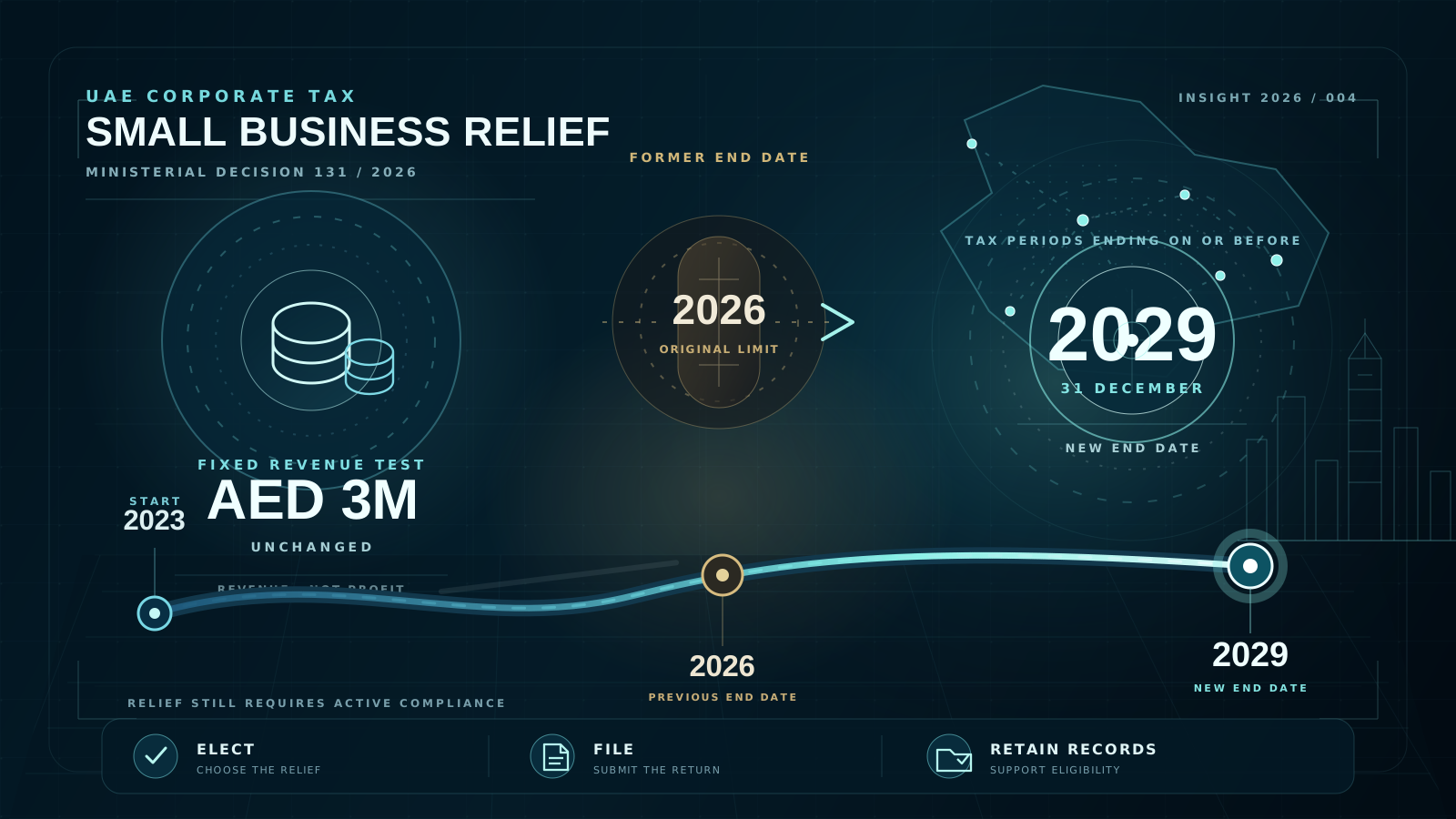
UAE reliefs need the same discipline. Small Business Relief may be elected for each period by an eligible Resident Person whose revenue—not profit—does not exceed AED 3 million in the current and all previous relevant periods, subject to its conditions and the current extension through tax periods ending on or before 31 December 2029. A Qualifying Free Zone Person cannot elect for it. The Free Zone 0% regime is not a generic reward for owning a Free Zone licence: qualifying income, adequate substance, transfer pricing, audited financial statements and the de minimis rule all matter.
Keep the company. Lose the fiction.
The good structure is not the one that moves the most profit across a border on paper. It is the one that can be described without lowering your voice and defended when an independent person asks who did what. The UK company may remain the right contracting vehicle, become a narrower support company or give way to a genuine UAE principal. The sensible answer may also be to keep one company until the commercial facts justify another.
By this point, the founder should be able to explain the arrangement without tax vocabulary: ‘The UK company keeps this client because procurement requires it; the UAE company wins the work, directs delivery and carries these risks.’ If the story only becomes convincing after the words ‘management fee’ appear, the structure has probably been designed backwards.
The decision becomes clearer when it is forced through five questions. If the answers cannot be written in ordinary language and supported with contracts, accounts and conduct, the structure is not ready.
- Why must the UK Ltd continue to exist?
- Where do the key people live and work?
- Where are prices, contracts and material risks decided?
- Is pre-existing value being transferred, licensed or left where it is?
- Does the net commercial benefit clearly exceed the second layer of compliance?
Primary sources
- HMRC — Company residence: overview ↗
- GOV.UK — 2016 UK–UAE Double Taxation Convention ↗
- HMRC — Transfer pricing between connected companies ↗
- HMRC — Common compliance risks in transfer-pricing approaches ↗
- HMRC — SME transfer-pricing exemption and exceptions ↗
- HMRC — Evidence for the wholly and exclusively test ↗
- HMRC — VAT Notice 741A: place of supply and reverse charge ↗
- UAE Federal Tax Authority — Corporate Tax General Guide ↗
- UAE Federal Tax Authority — Transfer Pricing Guide ↗
- UAE Ministry of Finance — Small Business Relief extended to 2029 ↗
- UAE Federal Tax Authority — Free Zone Persons guide ↗