
From a zero-tax assumption to an administered system
The introduction of federal Corporate Tax did not remove the UAE's commercial advantages. It changed the standard of execution. A credible UAE structure now combines commercial purpose with reliable accounts, registrations, returns and evidence that the legal structure matches the actual activity.
Corporate Tax applies to Tax Periods beginning on or after 1 June 2023. The first applicable period therefore depends on the financial year of the business rather than on one universal start or filing date.
Who is within scope?
The regime broadly covers UAE companies and other juridical persons incorporated in, or effectively managed and controlled from, the UAE. It can also apply to natural persons conducting specified business activities and to non-resident entities with a UAE permanent establishment or another relevant taxable connection.
Free Zone entities are Taxable Persons too. Incorporation in a Free Zone does not remove registration, accounting, filing or record-keeping obligations.
Rates and the calculation of taxable income
The general rates are 0% on taxable income up to and including AED 375,000 and 9% on taxable income above AED 375,000. The threshold applies to taxable income, not turnover or cash received.
The calculation generally begins with accounting profit or loss in the financial statements and is then adjusted under the Corporate Tax rules. Exempt income, non-deductible expenditure, interest limitations, reliefs and other statutory adjustments may alter the final taxable amount.
Small Business Relief
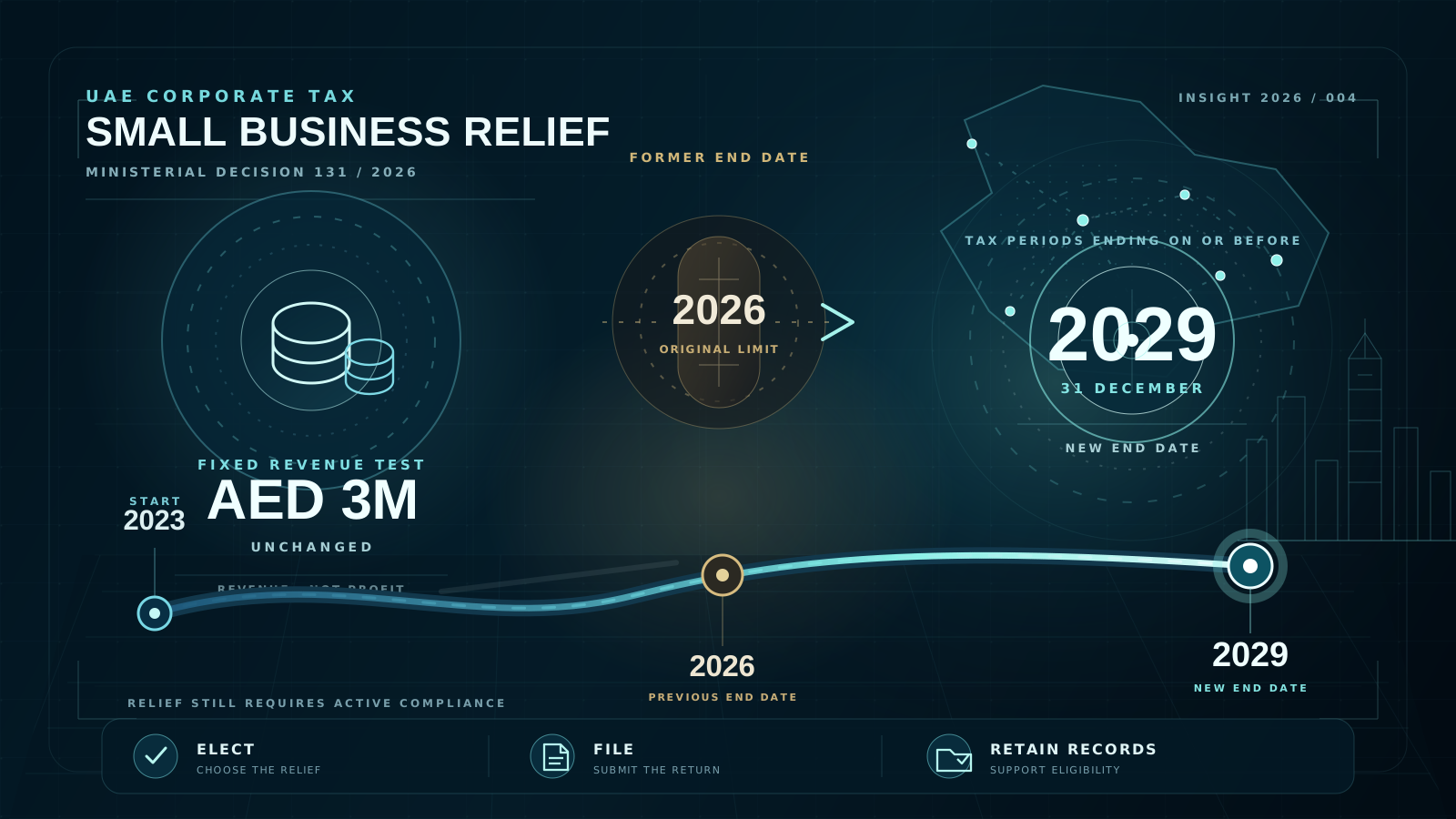
An eligible UAE Resident Person may elect for Small Business Relief where revenue does not exceed AED 3 million in the relevant Tax Period and all previous Tax Periods within the relief window. Ministerial Decision No. 131 of 2026 extended that window so the relief can apply to eligible Tax Periods ending on or before 31 December 2029.
The relief is not automatic and is not a blanket exemption from compliance. It is unavailable to Qualifying Free Zone Persons and members of certain large multinational groups. Records must still be retained, the arm's-length principle continues to apply, and the return must reflect the election correctly.
Free Zone companies
A Qualifying Free Zone Person may benefit from a 0% rate on Qualifying Income. Other taxable income may be subject to 9%, and the preferential regime is conditional rather than automatic.
The analysis may involve adequate substance, qualifying activities, the identity of counterparties, transfer-pricing compliance, audited financial statements where required, ownership or exploitation of intellectual property, permanent establishments, immovable property and the de minimis limit for non-qualifying revenue. A failure to satisfy the conditions can affect the regime for multiple periods.
Foreign income and cross-border operations
Income from customers outside the UAE is not automatically outside Corporate Tax. The result depends on the status of the person, where activities are performed, any permanent establishment, applicable exemptions, foreign tax relief and the detailed character of the income.
Equally, a foreign company can develop a UAE tax exposure through people, premises, management or dependent commercial activity. Contract wording should be tested against operational reality rather than considered in isolation.
The compliance cycle
A functioning Corporate Tax file begins long before the return. Businesses should determine their Tax Period, maintain financial records, register within the prescribed timetable, analyse elections and reliefs, document related-party transactions and reconcile the return to the accounts.
VAT and Corporate Tax are separate regimes. A company may have obligations under one, both or neither depending on the facts, but compliance with one never replaces the analysis required for the other.
- Keep bookkeeping current and preserve invoices, contracts and bank evidence.
- Close the accounts under an appropriate accounting framework and document tax adjustments.
- Review Free Zone status and qualifying income each period rather than relying on the trade licence label.
- Track revenue for Small Business Relief separately from taxable income and record any election.
- Identify related parties, connected persons and cross-border arrangements before year-end.
- File and pay within the statutory deadline applicable to the Tax Period.
What responsible planning now looks like
The strongest UAE structures are designed around operations: where decisions are made, who performs the work, which entity contracts, where value is created and how money moves. Tax treatment follows that commercial map.
The UAE remains competitive, but that advantage is not self-executing. Infrastructure and connectivity can support a structure; they cannot supply missing substance, repair weak accounts or change where decisions are actually made. The durable strategy is accurate accounting, commercial substance, properly documented transactions and timely compliance—not the assumption that every UAE or Free Zone company is tax-free.
UAE Corporate Tax and ongoing complianceOfficial references
- UAE Ministry of Finance — Corporate Tax in the UAE ↗
- UAE Ministry of Finance — Applicable taxable-income threshold ↗
- UAE Federal Tax Authority — Small Business Relief ↗
- UAE Ministry of Finance — Ministerial Decision No. 131 of 2026 extending Small Business Relief ↗
- UAE Ministry of Finance — Free Zone Corporate Tax decisions ↗