
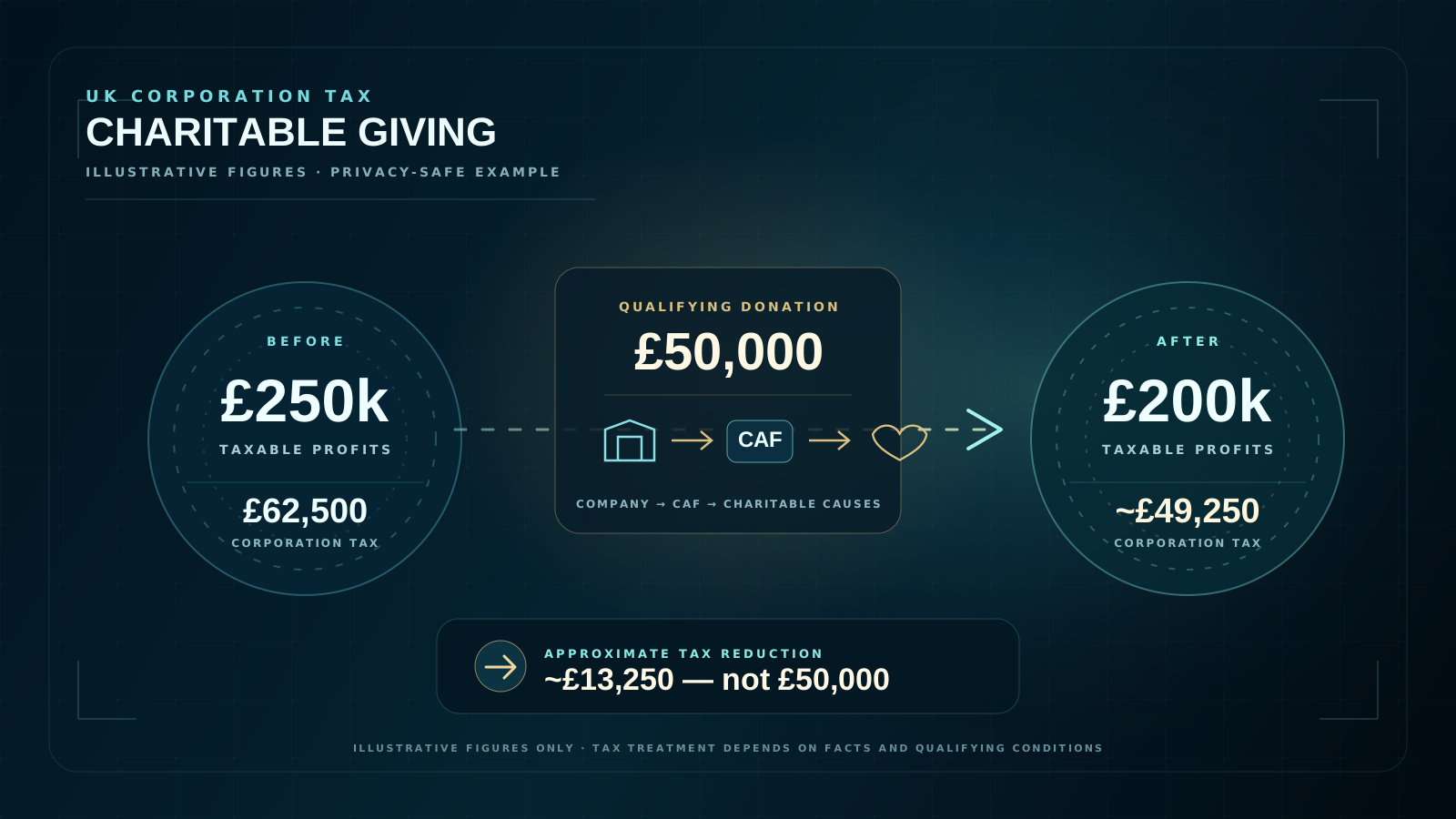
A composite scenario drawn from advisory work exposes a surprisingly common misunderstanding about corporate charitable giving in the UK.
The belief was simple: if a company donates £50,000, it should pay £50,000 less Corporation Tax. That is not how the relief works.
The company and figures are deliberately hypothetical. They illustrate the tax mechanics without reproducing a client file.
The misconception: ‘If I donate £50,000, I save £50,000 in tax’
In this composite scenario, the owner of a UK limited company was considering a substantial charitable contribution. Based on earlier advice, the owner understood that a £50,000 donation would reduce the company's Corporation Tax bill by £50,000.
That would effectively make the donation cost the company nothing. It also sounded too good to accept without checking.
So we went back to the primary source: HM Revenue & Customs. HMRC's published guidance states that a limited company can deduct the value of qualifying charitable donations from its total business profits before Corporation Tax is calculated.
That is a deduction from profits, not a pound-for-pound credit against the Corporation Tax bill.
A privacy-safe numerical example
Consider an entirely hypothetical UK company with £250,000 of taxable profits before qualifying charitable donations.
Assume a 12-month accounting period, no associated companies, no relevant exempt distributions affecting augmented profits, no other facts changing the normal Corporation Tax computation and that the donation qualifies for relief.
At £250,000 of taxable profits, the illustrative Corporation Tax charge is £62,500. A £50,000 qualifying donation reduces taxable profits to £200,000. Under the standard assumptions above, Corporation Tax is approximately £49,250 after Marginal Relief, producing an approximate tax reduction of £13,250.
- Before donation: £250,000 taxable profits → approximately £62,500 Corporation Tax.
- £25,000 donation: £225,000 taxable profits → approximately £55,875 Corporation Tax → approximately £6,625 tax reduction.
- £50,000 donation: £200,000 taxable profits → approximately £49,250 Corporation Tax → approximately £13,250 tax reduction.
- £75,000 donation: £175,000 taxable profits → approximately £42,625 Corporation Tax → approximately £19,875 tax reduction.
- £100,000 donation: £150,000 taxable profits → approximately £36,000 Corporation Tax → approximately £26,500 tax reduction.
What HMRC actually says
HMRC states that a limited company can pay less Corporation Tax when it gives money to a charity or Community Amateur Sports Club and that qualifying donations are deducted from total business profits before tax.
The payment still has to satisfy the relevant conditions. HMRC identifies payments that do not qualify, including loans that will be repaid by the charity, certain conditional payments and distributions of company profits such as dividends.
There are also rules where the company or a connected person receives something in return. The legal nature of the payment matters more than the label attached to it.
Where a CAF Company Account fits
A CAF Company Account can be useful when a company wants to establish a charitable budget but has not yet decided which organisations should ultimately receive the funds.
Charities Aid Foundation describes the Company Account as a structure in which the company contributes funds to CAF, which then holds them until the business requests distributions for charitable purposes.
CAF states that contributions by a company into the Company Account are considered a charitable donation when the funds are transferred to CAF. This can separate the date on which the company commits the charitable funds from the later choice of supported causes.
CAF also states that it verifies charity partners before distributing funds, which can be valuable when a company wants to support a wider range of organisations.
Timing matters: the accounting period cannot be rewritten afterwards
HMRC says the relief should be claimed in the Company Tax Return covering the accounting period during which the donation was made.
The total qualifying donations are entered in the ‘Qualifying donations’ field within Deductions and Reliefs in the Company Tax Return.
A company therefore cannot generally wait until the tax result for an earlier accounting period is known, make a new donation afterwards and simply allocate that donation back to the closed period.
The relief has limits
HMRC states that the maximum deduction is the amount that reduces the company's profits to zero.
If qualifying charitable donations exceed total profits, the excess does not simply create an ordinary trading loss to carry forward. The detailed interaction with other reliefs depends on the company's circumstances.
For owner-managed businesses, the practical point is to consider the charitable budget alongside expected taxable profits, cash position and wider financial objectives.
Donation, sponsorship and commercial benefit are different concepts
Companies sometimes describe every payment to a charity as a donation, but tax law distinguishes different arrangements.
A sponsorship payment can be different because the company receives something connected with its business in return, such as publicity, use of branding or product promotion. HMRC's guidance treats qualifying sponsorship costs as business expenses rather than charitable donations.
The correct tax treatment therefore depends on what the transaction actually is, not merely what it is called.
Why primary sources matter
This is not really a story about one £50,000 donation. It is a story about how tax errors begin.
A sentence such as ‘you can deduct the donation from your tax’ can quietly mutate into ‘the donation comes off the tax bill’. A deduction from taxable profits becomes a tax credit, and a material financial decision is made on the basis of something nobody checked.
For material tax decisions, the better process is to identify the transaction, jurisdiction and accounting period; verify the applicable legislation or tax-authority guidance; distinguish a deduction from a credit, exemption or allowance; calculate the economic effect; and document the conclusion before acting.
The practical conclusion
Corporate charitable giving can be both socially valuable and tax-efficient.
For a UK limited company, qualifying charitable donations can reduce the profits on which Corporation Tax is calculated. CAF can provide a practical structure for committing and administering a charitable budget while leaving the final choice of supported causes until later.
The relevant question is not how large the donation sounds, but what legal treatment applies, when the payment is made and what the calculation actually produces.
Planning a material donation properly is not aggressive tax. It is understanding the rules before money moves.
Primary sources
- HM Revenue & Customs / GOV.UK — Donating money ↗
- HM Revenue & Customs / GOV.UK — How to claim ↗
- HM Revenue & Customs / GOV.UK — Corporation Tax Marginal Relief ↗
- HMRC Company Taxation Manual — CTM03925: Marginal Relief ↗
- HMRC Company Taxation Manual — CTM09010: qualifying charitable donations ↗
- HM Revenue & Customs / GOV.UK — Sponsoring a charity ↗
- Charities Aid Foundation — CAF Company Account ↗