I have a simple rule: when an international structure starts with the company rather than the person, the analysis has started at the wrong end.
Monday, 8.12 am. Madrid. Alex—a hypothetical character, not a client or a disguised real case—approves a proposal, answers a client and opens the app for his US account. The screen shows dollars. The card is American. The certificate says Wyoming. Everything seems to be elsewhere except the person doing the work.
The theory runs like this: the company is there, the money is there and the owner is not American. All three facts may be true. None of them makes Spain disappear.
An LLC can organise contracts, liability, payments and operations. It cannot emigrate on its owner's behalf. If life remains in Madrid, the analysis starts in Madrid. Everything else follows.
A certificate cannot make the move for you
On Monday, Alex approves a proposal from Madrid. On Tuesday, he signs a contract after a meeting on Gran Vía. The following week, he reviews invoices from Barcelona, between Carrer de Blai and the Sagrada Família. Those places do not by themselves determine tax residence; Spanish residence is fixed as a premise here. They do show where he is while working and making decisions.
The assumptions are explicit. Alex is an individual tax resident in Spain under the general IRPF regime. He is neither a US citizen nor a US tax resident. He owns a single-member Wyoming LLC with no election to be taxed as a corporation, serves international clients, performs most of the work from Spain and has no material US presence.
Wyoming still matters. It establishes where the LLC was formed, its legal existence, registered agent and state maintenance. The certificate does not decide how Spain classifies the entity, who earns the income, where services are performed or what the owner must report.
The company has its own legal geography; the person keeps theirs. Confusing the two does not create mobility. It merely hides the question that should have been answered first.
EUR 36,000 is a movement, not an answer
Alex opens the app and points to a transfer: ‘I only took out EUR 36,000.’ We now know how much cash reached his personal account. We still do not know how much profit the activity produced or how Spain should treat it.
A single-member LLC may be disregarded for US federal income-tax purposes. Spain does not simply import that label. It examines whether the foreign entity is itself subject to a personal tax, whether income is attributed as it arises and whether it retains its character. Documents, tax elections and actual operation matter.
For an individual tax resident in Spain under the general IRPF regime, the general rule is taxation on worldwide income wherever the payer is located. The LLC's classification affects who is treated as earning the income and when. Special regimes, foral rules or different facts would require a separate analysis.
Fix the figures: EUR 120,000 received from unrelated clients, EUR 20,000 of documented expenses assumed deductible in Spain, a non-deductible EUR 36,000 distribution—not salary, a loan or a reimbursement—and EUR 64,000 left in the account. There was no opening balance and there were no other movements.
Under the classification expressly assumed here—an entity analogous to an income-attribution entity—the result is EUR 100,000 and Spain attributes it to the owner. The EUR 36,000 explains a cash movement; it does not cap that result. Nor does leaving the other EUR 64,000 in the United States create an automatic tax deferral. The personal calculation will depend on other income, autonomous-community rules and personal circumstances.
The LLC interest and certain rights over foreign accounts may also require separate Modelo 720 analysis depending on ownership, authority, thresholds and the nature of the entity. It is not accurate to say that the LLC and every underlying asset are always reported twice.
What does not travel automatically does not disappear
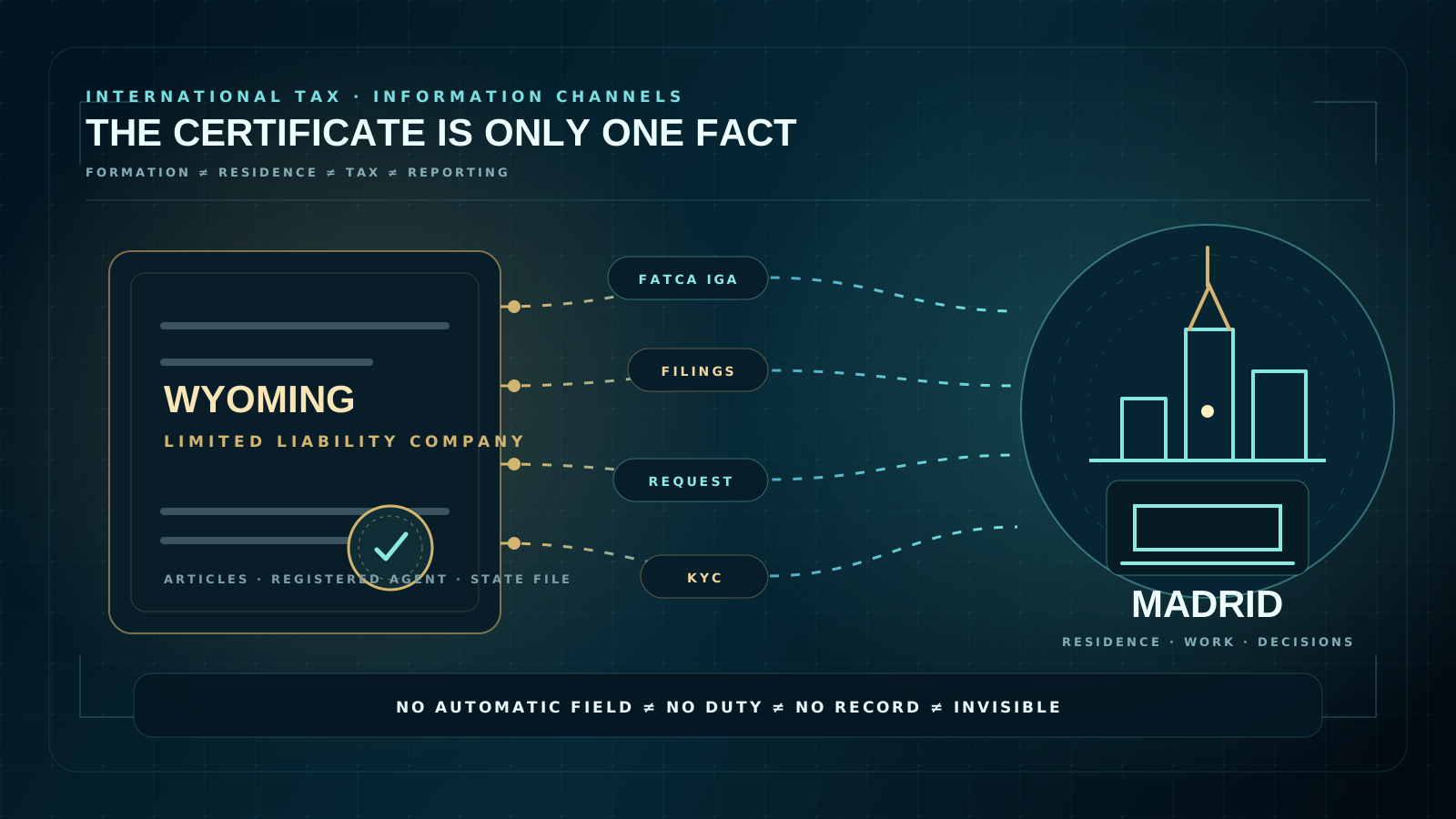
The statement ‘The United States is not in CRS’ is true. The conclusion ‘therefore nothing is reported’ is not. Spain and the United States have an intergovernmental agreement that implements FATCA and creates an annual automatic-exchange channel.
The US-to-Spain flow is narrower than the reverse. It covers specified identifying data and gross amounts of certain US-source income, but it does not automatically transmit every balance or movement in an account held by an LLC. That limit describes one channel; it does not answer the rest.
Automatic exchange, self-reporting duties, requests and KYC are different mechanisms. Article 27 of the Spain–US treaty allows the exchange, on request, of information that is foreseeably relevant within its scope. It is neither an indiscriminate data dump nor FATCA: it follows a different procedure.
The LLC also retains its US filing position. A foreign-owned US disregarded entity may have to file Form 5472 with a pro forma Form 1120 where reportable transactions with its owner or related parties exist. The pro forma does not mean that the LLC elected to be taxed as a C corporation; it is the vehicle for the information return. The base penalty for failing to file Form 5472 correctly is USD 25,000.
The current BOI exemption for US-created domestic entities does not amount to anonymity either. State records, IRS filings, KYC and lawful requests remain separate layers.
Mercury and Relay operate through partner banks and retain information about the company and the people identified during onboarding. That KYC creates traceability, but it does not mean that the whole file is automatically transmitted to Spain or that the bank has approved the owner's tax treatment. The interface shows the balance. It does not close the analysis.
The LLC may be sound. The story must be too
Do not make the opposite mistake. An LLC may be a sound legal and commercial structure: it can limit liability, organise ownership, facilitate contracts or provide useful operating infrastructure. FATCA, Form 5472 and KYC do not make a lawful structure suspicious.
The criticism is aimed at the idea that one label can create a Spanish exemption, a uniform international classification, banking invisibility and no US obligations all at once. No vehicle can bear that weight.
If the owner works and makes decisions from Paris, Berlin, São Paulo or Madrid, the Wyoming certificate does not change. The country that must analyse residence, activity, classification and income does. The relevant geography does not disappear; its name changes.
If the owner genuinely leaves Spain and establishes life and activity elsewhere, the analysis must be rebuilt. A real move can have real consequences. Forming a company is not a substitute for it.
A sound structure can demonstrate where the person is resident, where the work happens, how the entity is classified, what the business earns, what the owner receives and which duties apply. It need not be impressive. It must be coherent.
International tax structuring for foundersPrimary and first-party sources
- Spanish Official Gazette — Spain–US FATCA Agreement ↗
- Spanish Official Gazette — 2013 Protocol to the Spain–US tax treaty ↗
- Spanish Official Gazette — Spanish individual income tax law ↗
- Spanish Directorate-General for Taxation — foreign entity classification criteria ↗
- Spanish Tax Agency — Modelo 720 practical questions ↗
- Internal Revenue Service — Instructions for Form 5472 ↗
- Internal Revenue Service — Instructions for Form 1042-S ↗
- Internal Revenue Service — source of personal-service income ↗
- Mercury — legal disclosures and banking providers ↗
- Relay — terms and banking providers ↗
- FinCEN — Beneficial Ownership Information reporting ↗