
The UAE has extended one of the most useful parts of its Corporate Tax regime for small businesses.
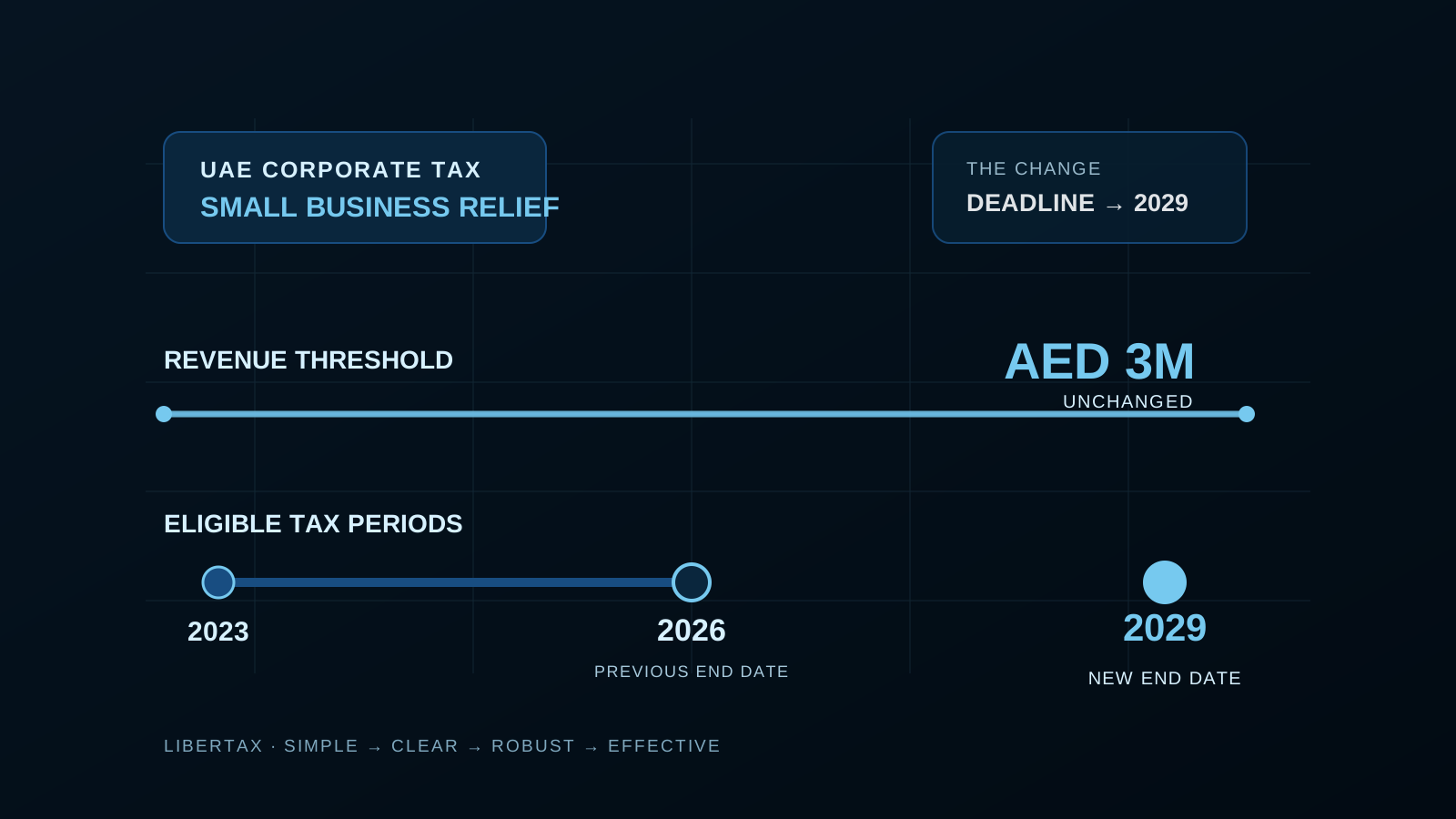
Ministerial Decision No. 131 of 2026 extends the period during which the AED 3 million Small Business Relief threshold can apply. Tax Periods commencing on or after 1 June 2023 can remain within the regime where the relevant conditions are satisfied and the Tax Period ends on or before 31 December 2029.
The previous end date was 31 December 2026. That is the change. The eligibility test itself has not been relaxed.
What exactly changed?
The UAE has extended the existing Small Business Relief window by three years, from the end of 2026 to the end of 2029.
Ministerial Decision No. 131 of 2026 amends the timing rule in Ministerial Decision No. 73 of 2023 so that the AED 3 million threshold continues to apply to eligible Tax Periods ending on or before 31 December 2029.
The new Decision does not change the AED 3 million threshold or replace the other eligibility conditions in the original Small Business Relief rules.
For a business already using Small Business Relief, the practical effect is straightforward: the regime does not disappear after the 2026 Tax Period merely because the original sunset date has arrived. If the business continues to satisfy the conditions, it may potentially elect for the relief in eligible Tax Periods through 2029.
AED 3 million means Revenue, not profit
The threshold is measured against Revenue, not taxable profit or accounting profit.
A business may have Revenue below AED 3 million and a relatively high profit margin, or Revenue above AED 3 million while making little or no profit. For Small Business Relief, it is the Revenue test that matters.
- Revenue must be AED 3,000,000 or less in the relevant Tax Period.
- Revenue must also have been AED 3,000,000 or less in all previous relevant Tax Periods.
- Once the threshold has been exceeded in a relevant Tax Period, a later fall below AED 3 million does not restore Small Business Relief eligibility.
Who can elect for Small Business Relief?
Small Business Relief is available to eligible UAE Resident Persons, subject to the Revenue test and specific exclusions.
The regime can apply to a Resident Person that is a juridical person or a natural person where that person is within the scope of UAE Corporate Tax and satisfies the relevant conditions.
The Free Zone point requires precision. Incorporation in a UAE Free Zone is not, by itself, the exclusion. The specific exclusion is for a Qualifying Free Zone Person, so a Free Zone business needs to establish its actual Corporate Tax status rather than assume that every Free Zone company is treated identically.
Artificially separating a Business or Business Activity to remain below the AED 3 million threshold can also be challenged under the Corporate Tax anti-abuse rules.
- Qualifying Free Zone Persons cannot elect for Small Business Relief.
- Members of qualifying multinational groups within the UAE Country-by-Country Reporting framework are excluded; the relevant consolidated group Revenue threshold is AED 3.15 billion.
What does the relief actually do?
Where an eligible Taxable Person elects for Small Business Relief, it is treated as having no Taxable Income for that Tax Period.
That is different from saying that every business with Revenue below AED 3 million simply has a 0% Corporate Tax rate. The normal UAE Corporate Tax rate structure and Small Business Relief are separate concepts.
- The Taxable Person is treated as having no Taxable Income for the relevant Tax Period.
- A simplified Corporate Tax Return can be filed instead of calculating the full taxable-income position.
- Normal transfer-pricing documentation is not required for the elected period, although the arm's length principle still applies.
- Tax Losses arising in a period for which Small Business Relief is elected cannot be accrued or used for that period, while qualifying losses from earlier periods may remain available later subject to the normal rules.
Small Business Relief does not remove the filing obligation
Eligibility for Small Business Relief does not mean that the business can ignore Corporate Tax compliance.
The election is part of compliance, not an alternative to compliance. Reliable accounting records still matter even where no Corporate Tax is ultimately payable under the relief.
- Register for Corporate Tax where required.
- Elect for Small Business Relief in the Corporate Tax Return for each relevant Tax Period.
- Submit the required simplified Corporate Tax Return.
- Retain records and supporting documents that demonstrate Revenue and eligibility.
- Meet the applicable filing deadline, generally within nine months from the end of the Tax Period.
Three simple examples
The Revenue history usually tells you quickly whether the AED 3 million test is still available.
- Example A — Revenue of AED 2.1m in 2024, AED 2.6m in 2025, AED 2.9m in 2026 and AED 2.7m in 2027: assuming the other conditions are met, the business may potentially elect because Revenue has not exceeded AED 3m.
- Example B — Revenue of AED 3.2m in 2025 and AED 1.9m in 2026: the later fall does not restore eligibility because the threshold was exceeded in a previous relevant Tax Period.
- Example C — Company A has AED 2.8m Revenue and AED 1.1m profit; Company B has AED 3.1m Revenue and makes a loss: Company A may potentially meet the Revenue condition, while Company B does not despite having no profit.
What should small UAE businesses do now?
The extension is useful, but the right response is to verify eligibility rather than simply assume another three years of zero tax.
- Reconstruct Revenue by Tax Period from the first relevant Corporate Tax period onward.
- Check whether AED 3 million was ever exceeded; a historical breach can remove access to the relief for later periods.
- Confirm the entity's Corporate Tax status, particularly for Free Zone businesses and groups.
- Make the election correctly in each Corporate Tax Return where Small Business Relief is being claimed.
- Keep the evidence: Revenue records, transactions, assets, liabilities and ownership records may be needed to support the return and the relief claimed.
The practical conclusion
Small Business Relief is now a longer-lived part of the UAE Corporate Tax regime, but it remains a conditional relief rather than a blanket exemption for small companies.
The headline is simple: the UAE has moved the end date from 2026 to 2029. The rules underneath it still matter.
- AED 3 million is a Revenue threshold.
- The test looks at the current and previous relevant Tax Periods.
- A previous breach matters.
- Qualifying Free Zone Persons and certain large multinational-group members are excluded.
- Registration, election, filing and record keeping remain necessary.
Primary sources
- UAE Ministry of Finance — Ministerial Decision No. 131 of 2026 amending the Small Business Relief rules ↗
- UAE Ministry of Finance — Ministerial Decision No. 73 of 2023 / original Small Business Relief framework ↗
- Federal Tax Authority — Small Business Relief Corporate Tax Guide (CTGSBR1), August 2023 ↗
- Federal Tax Authority — eligible Small Business Relief taxpayers must submit simplified Corporate Tax Returns within the legal deadline, 3 August 2026 ↗